
Commerce platform
The full-stack power of a major platform.
Your code, your data, your rules. Enterprise-grade management for orders, inventory, and global markets, without the transaction fees or the walled garden.
Why this stack
Your Code. Your Data. Your Rules.
Own the entire commerce stack with open-source flexibility. Build exactly what your business needs—no add-on tax, no closed extensions.

Your Code
Customize every layer, from checkout flows to fulfillment logic. Extend with any framework or third‑party service. No plugin limits.

Your Data
Keep product, customer, and order data in your own databases. Portable schemas, easy exports, and clean migration. No vendor lock‑in.

Your Rules
Set pricing, promotions, and workflows on your terms. Zero transaction fees and fully customizable business logic.
Technology stack
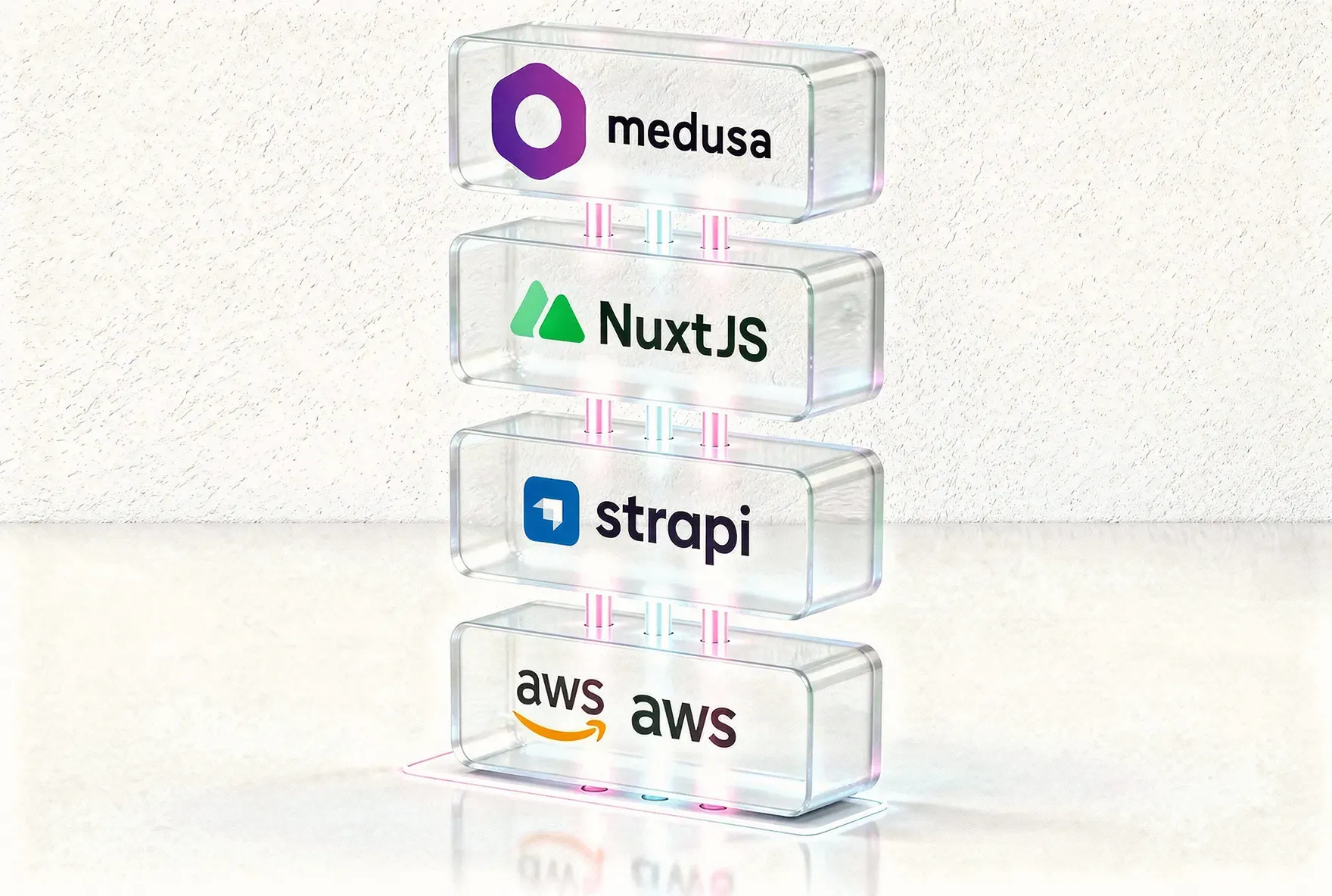
Medusa JS + Strapi JS + Nuxt JS
A modular, headless architecture that scales with your roadmap.
Medusa JS
Commerce engine with flexible APIs for carts, pricing, promotions, shipping, and payments. Event-driven architecture and microservices‑ready.
Strapi CMS
Headless content management for structured catalogs and localization. Role-based permissions, versioning, and editorial workflows out of the box.
Nuxt JS
Vue-powered storefronts with hybrid rendering (SSR/ISR), excellent performance, and SEO built-in. First‑class DX and component reusability.
Built for enterprise
Scale globally with confidence.
Enterprise scalability
Horizontally scalable services with queues, caching, and observability for peak traffic and major launches.
Multi‑currency and multi‑language
Localized catalogs and checkout with currency‑aware pricing, taxes, and rounding rules.
Advanced inventory management
Multi‑warehouse stock, reservations, backorders, and real‑time availability across channels.
Global order processing
Cross‑border payments, duties, shipping rules, and automated fulfillment workflows.
Why choose open over closed
Everything you expect from a major platform, without the trade‑offs.
Own your roadmap, keep your margin, and integrate on your terms.

No platform transaction fees
Stop paying tax on your platform. Keep margins high at scale.

Your hosting, your cloud
Run on your preferred cloud and region. Full control over cost, performance, and compliance.

Unlimited API integrations
Connect ERPs, PIMs, search, CDPs, and anything you need.
READY TO SCALE?
Unlock your true commerce potential
See how Syrma transforms rigid stores into fluid, global commerce engines. Let's discuss your current bottlenecks and map out a custom architecture that fits your growth goals.
"Finally, a partner that speaks our language. The modular approach allowed us to keep what worked, replace what didn't, and scale without downtime."